Kidult Tech Blog | AI Plush OEM Insights
AI plush industry trends, OEM/ODM guidance & development insights for brands
How Long Does It Take to Develop an AI Toy?
One of the first questions brands ask after deciding to develop an AI toy is:
"How long will the project take?"
The honest answer is that there is no universal timeline.
Every AI toy project is different.
Some projects build upon an existing AI platform, while others require completely new hardware, software, and AI integration.
Rather than promising a fixed schedule, professional AI toy development starts by understanding the product goals and selecting the most appropriate development path.
At Kidult Tech, we believe successful projects are achieved through structured planning—not by rushing the process.
In this guide, we'll explain the typical development stages, the factors that influence project timelines, and how brands can shorten development without sacrificing product quality.
1. Every AI Toy Project Is Different
Unlike ordinary plush toys, AI toys combine multiple disciplines into one product.
A typical project may involve:
- Industrial design
- Plush design
- Electronics engineering
- Embedded software
- AI integration
- Voice interaction
- Mobile application
- Product testing
- Certification
- Manufacturing preparation
Each project has its own level of complexity.
This is why development timelines vary depending on the product requirements.
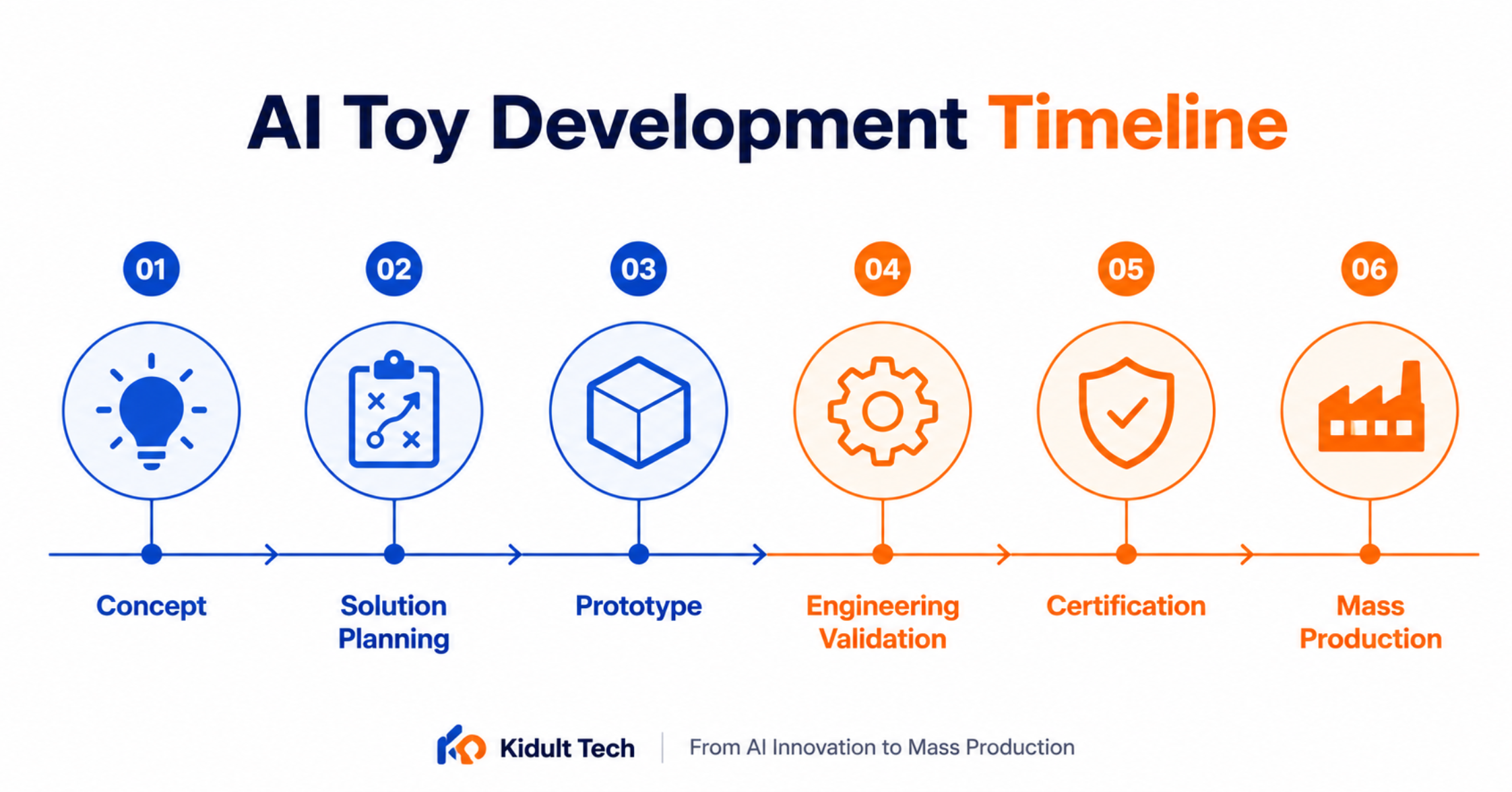
2. The Typical AI Toy Development Process
Although every project is unique, most AI toy development projects follow a structured process.
Phase 1 — Product Definition
Every successful project begins with a clear understanding of the product.
This stage focuses on questions such as:
- Who is the target user?
- What problem does the product solve?
- Which AI functions are required?
- What is the target retail price?
- Which markets will the product be sold in?
The better these questions are answered, the smoother the development process becomes.
Phase 2 — Solution Planning
Once the product direction is confirmed, the development team evaluates the most suitable technical solution.
Depending on the project, this may include decisions about:
- AI architecture
- Offline AI, cloud AI, or hybrid AI
- Electronics platform
- Connectivity
- Power management
- Software requirements
Choosing the right technical strategy at this stage helps reduce future development risks.
Phase 3 — Prototype Development
During this phase, the first working prototype is created.
The objective is to validate:
- Product appearance
- Structural design
- Electronics
- AI interaction
- User experience
Prototype testing often leads to design improvements before manufacturing begins.
Phase 4 — Engineering Validation
Before mass production, the engineering team verifies that the product is stable, reliable, and ready for manufacturing.
Typical activities include:
- Functional testing
- Reliability testing
- Structural optimization
- Firmware refinement
- User experience improvements
This stage reduces manufacturing risks later in the project.
Phase 5 — Certification & Manufacturing Preparation
Before entering production, products may require certification depending on the target market.
Manufacturing preparation also includes:
- Tooling verification
- Production process validation
- Quality standards
- Packaging confirmation
- Supply chain planning
Completing these activities early helps ensure a smoother production launch..
Phase 6 — Mass Production
Once validation is complete, the project moves into volume manufacturing.
At this stage, the focus shifts toward:
- Production efficiency
- Quality consistency
- Delivery planning
- Global logistics support
A well-prepared development process significantly reduces delays during production.
3. What Affects the Development Timeline?
Several factors influence how long an AI toy project will take.
Development Scope
Projects built on an existing AI platform are generally completed more quickly than projects requiring entirely new hardware and software.
Product Complexity
Additional AI capabilities, sensors, connectivity options, and mechanical functions increase development effort.
Customization Level
Minor appearance changes require less time than complete industrial design and hardware development.
Certification Requirements
Products entering different international markets may require different testing and certification procedures.
These requirements should be considered early during development.
Customer Decision Speed
One often-overlooked factor is project communication.
Timely feedback, design approvals, and technical decisions help keep projects moving efficiently.
4. How to Shorten Development Without Increasing Risk
Many brands assume that accelerating development means working faster.
In reality, the best way to reduce development time is to make better decisions earlier.
At Kidult Tech, we often recommend:
- Defining product goals clearly before engineering begins
- Reusing proven AI platforms when appropriate
- Prioritizing core user experiences in Version 1
- Planning future upgrades instead of adding every feature initially
This phased approach helps brands launch sooner while maintaining flexibility for future product evolution.
5. Our Recommended Development Strategy
Rather than trying to create the perfect AI toy in the first release, we encourage brands to think in stages.
Stage 1 — Define the Product Vision
Clarify your business objectives, users, and product positioning.
↓
Stage 2 — Build & Validate
Develop a prototype and evaluate the product through testing.
↓
Stage 3 — Launch & Learn
Introduce the product to the market and collect real user feedback.
↓
Stage 4 — Optimize & Scale
Refine hardware, software, and manufacturing based on market performance before scaling production.
This methodology reduces development uncertainty while supporting continuous product improvement.
6. Start Planning Early
One common misconception is that development only begins when engineering starts.
In reality, successful projects begin much earlier—with planning.
The earlier key decisions are made, the easier it becomes to manage budgets, timelines, certifications, and production.
Even if your product concept is still evolving, discussing your ideas with an experienced development partner can help identify potential risks and create a realistic roadmap.
Conclusion
There is no fixed answer to the question:
"How long does it take to develop an AI toy?"
The timeline depends on the project's goals, technical scope, level of customization, and development strategy.
Rather than focusing on the shortest possible schedule, successful brands focus on building the right product through a structured development process.
At Kidult Tech, we help brands plan realistic timelines, recommend practical technical solutions, and guide projects from concept to mass production through a transparent and collaborative development process.
Frequently Asked Questions
Can an AI toy be developed faster by using an existing platform?
Yes. Building on a proven AI platform can significantly reduce engineering effort and accelerate development while still allowing extensive customization of the product experience.
Does every AI toy require a mobile app?
Not necessarily. Some AI toys operate independently, while others integrate with mobile applications or cloud services depending on the product requirements.
What is the longest stage in AI toy development?
The timeline varies by project. Product definition, prototype validation, engineering optimization, and certification are often the stages that have the greatest impact on the overall schedule.
Can development and manufacturing preparation happen at the same time?
In many cases, yes. Once the product design becomes stable, manufacturing preparation and supply chain planning can progress alongside final engineering validation to improve overall project efficiency.
Please give us a message