Kidult Tech Blog | AI Plush OEM Insights
AI plush industry trends, OEM/ODM guidance & development insights for brands
Ready-to-Sell vs Custom AI Toys: Which Solution Is Right for Your Brand?
As AI companion toys continue to grow in popularity, many brands are asking the same question:
Should we start with a ready-to-sell AI product, or invest in a fully customized solution?
At first glance, the answer may seem simple. A ready-to-sell platform is faster, while custom development offers greater flexibility.
However, after working with brands, startups, IP owners, and retailers on AI toy projects, we've found that the real question is not "Which option is better?"
It's:
Which development strategy gives your project the highest chance of success?
The best decision depends on your business goals, launch timeline, budget, and long-term product strategy.
In this guide, we'll explain the differences between ready-to-sell AI platforms and fully customized AI toy development—and help you decide which approach is right for your brand.
1. Two Different Ways to Build an AI Toy
Most AI toy projects follow one of two development paths.
The first is to build on an existing AI platform that has already been developed and tested.
The second is to create a completely new product from the ground up.
Neither approach is universally better.
Each serves different business objectives.
Understanding these differences is the first step toward making the right investment.
2. What Is a Ready-to-Sell AI Platform?
A ready-to-sell AI platform is not simply an existing toy with a different logo.
It is a proven hardware and software foundation that can be adapted to create different AI products.
Instead of redeveloping every component, brands build on technology that has already been validated.
Depending on the project, a ready platform may already include:
- AI hardware architecture
- Electronics
- Firmware
- Voice interaction
- Wireless connectivity
- Battery management
- Manufacturing process
- Quality control standards
This allows development efforts to focus on creating a unique product experience rather than rebuilding the underlying technology.
For many projects, this significantly reduces development time and technical risk.
3. What Can Be Customized?
Choosing a ready platform does not mean sacrificing your brand identity.
Many aspects of the product can still be customized, including:
- Plush appearance and character design
- Product size and materials
- Brand identity
- Packaging
- AI personality
- Voice style
- Languages
- User interaction
- Mobile application (depending on project requirements)
- Accessories and retail presentation
In other words, the technology foundation may already exist, while the customer experience remains unique to your brand.
This approach allows companies to launch differentiated products without rebuilding the entire system.
4. When Is a Ready-to-Sell Platform the Right Choice?
Based on our project experience, a ready-to-sell platform is often the best choice when:
- You're entering the AI toy market for the first time.
- You want to validate market demand before making a larger investment.
- Your launch schedule is tight.
- You're preparing for crowdfunding or an early product release.
- You want to reduce development risk.
- You prefer to focus on branding and customer experience rather than building the underlying technology.
For many brands, launching a successful Version 1 provides valuable market feedback that helps shape future product development.
Starting with a proven platform often leads to faster learning and lower overall project risk.
5. When Does Fully Customized Development Make Sense?
Custom development is the right choice when your product requires capabilities that cannot be achieved through an existing platform.
Examples include:
- A completely new hardware design
- Proprietary AI interaction
- A dedicated mobile application and cloud platform
- Unique electronic functions
- Exclusive industrial design
- Long-term product ecosystems
- High-volume product strategies
- Deep integration with an existing IP or digital service
Custom development offers maximum flexibility, but it also requires greater engineering resources, longer development cycles, and a higher initial investment.
For established brands planning a long-term AI product roadmap, these investments can create strong competitive advantages.
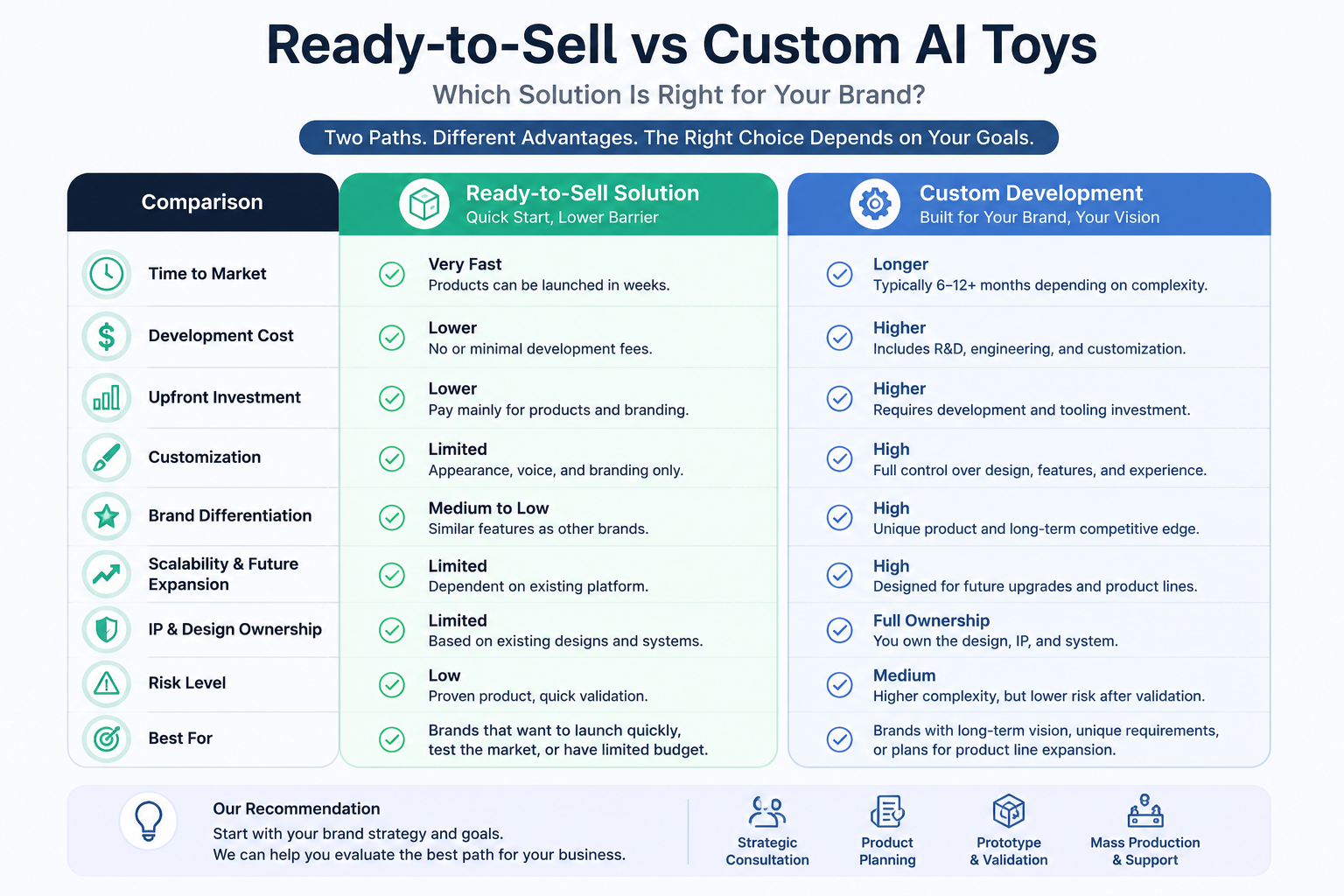
6. Ready-to-Sell vs Custom AI Toys
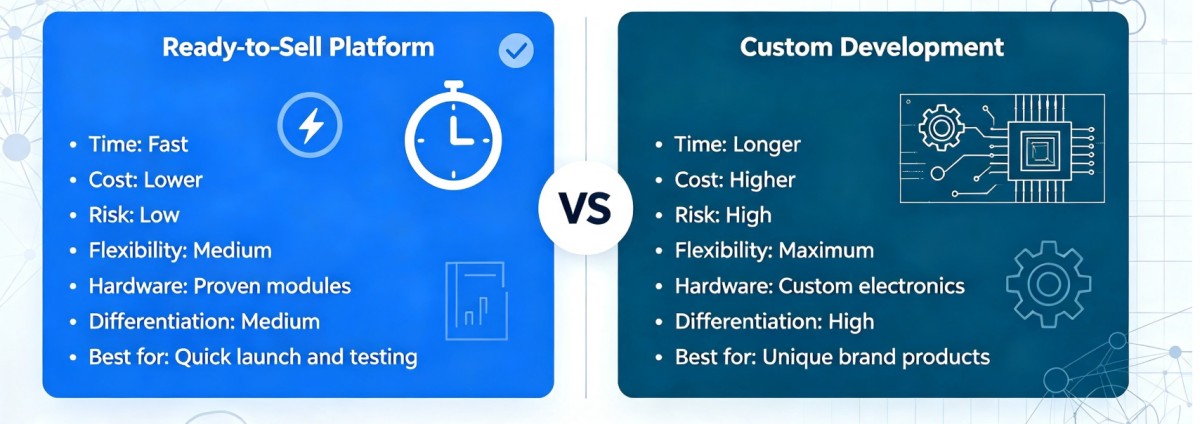
The goal is not simply to choose the faster or more advanced option.
It's to select the development path that best matches your business stage and product strategy.
7. Our Recommended Development Strategy
One of the biggest mistakes companies make is trying to build everything from scratch before validating the market.
In many cases, we recommend a phased development approach.
Stage 1
Build your first product using a proven AI platform.
Focus on:
Product positioning
User experience
Branding
Customer feedback
Market validation
Stage 2
Analyze real customer usage and identify opportunities for improvement.
Evaluate which features create the most value and where further investment is justified.
Stage 3
Develop a fully customized product if additional functionality, unique hardware, or deeper AI integration becomes necessary.
This phased strategy helps reduce technical risk, shorten development time, and allocate engineering resources more efficiently.
Rather than making the largest investment at the beginning, brands can make better decisions based on real market feedback.
8. Which Option Is Right for Your Brand?
There is no universal answer.
If your priority is launching quickly, testing the market, or minimizing development risk, a ready-to-sell AI platform is often the smartest starting point.
If your goal is to build a highly differentiated AI product with unique hardware, software, and long-term product ownership, custom development may be the better investment.
Many successful AI products don't begin as fully custom projects.
They begin with a smart strategy.
Conclusion
Choosing between a ready-to-sell AI platform and fully customized development is not simply a technical decision.
It is a business decision.
The most successful brands focus first on creating value for users, validating the market, and building a sustainable product roadmap.
At Kidult Tech, we support both approaches.
Whether you're looking to launch quickly using an existing AI platform or develop a fully customized AI companion product, we help transform ideas into market-ready products through professional AI toy development and manufacturing.
Frequently Asked Questions
Can I customize the appearance of a ready-to-sell AI toy?
Yes. Most ready-to-sell platforms allow customization of the plush design, branding, packaging, AI personality, languages, and other user-facing features while leveraging a proven technology platform.
Is a ready-to-sell AI toy only suitable for startups?
No. Established brands also use ready platforms to accelerate product launches, test new product categories, or validate market demand before investing in full custom development.
Does custom development always mean building everything from scratch?
Not necessarily. Depending on the project, certain technologies or modules can still be reused while developing customized hardware, software, or user experiences.
Can I start with a ready platform and upgrade later?
Yes. Many brands begin with a ready platform to validate the market and later transition to a more customized solution as their product line grows.
Which solution does Kidult Tech recommend?
The best solution depends on your business goals, launch timeline, budget, and long-term strategy. We help customers evaluate both options and recommend the development path that best fits their project.
Please give us a message