Kidult Tech Blog | AI Plush OEM Insights
AI plush industry trends, OEM/ODM guidance & development insights for brands
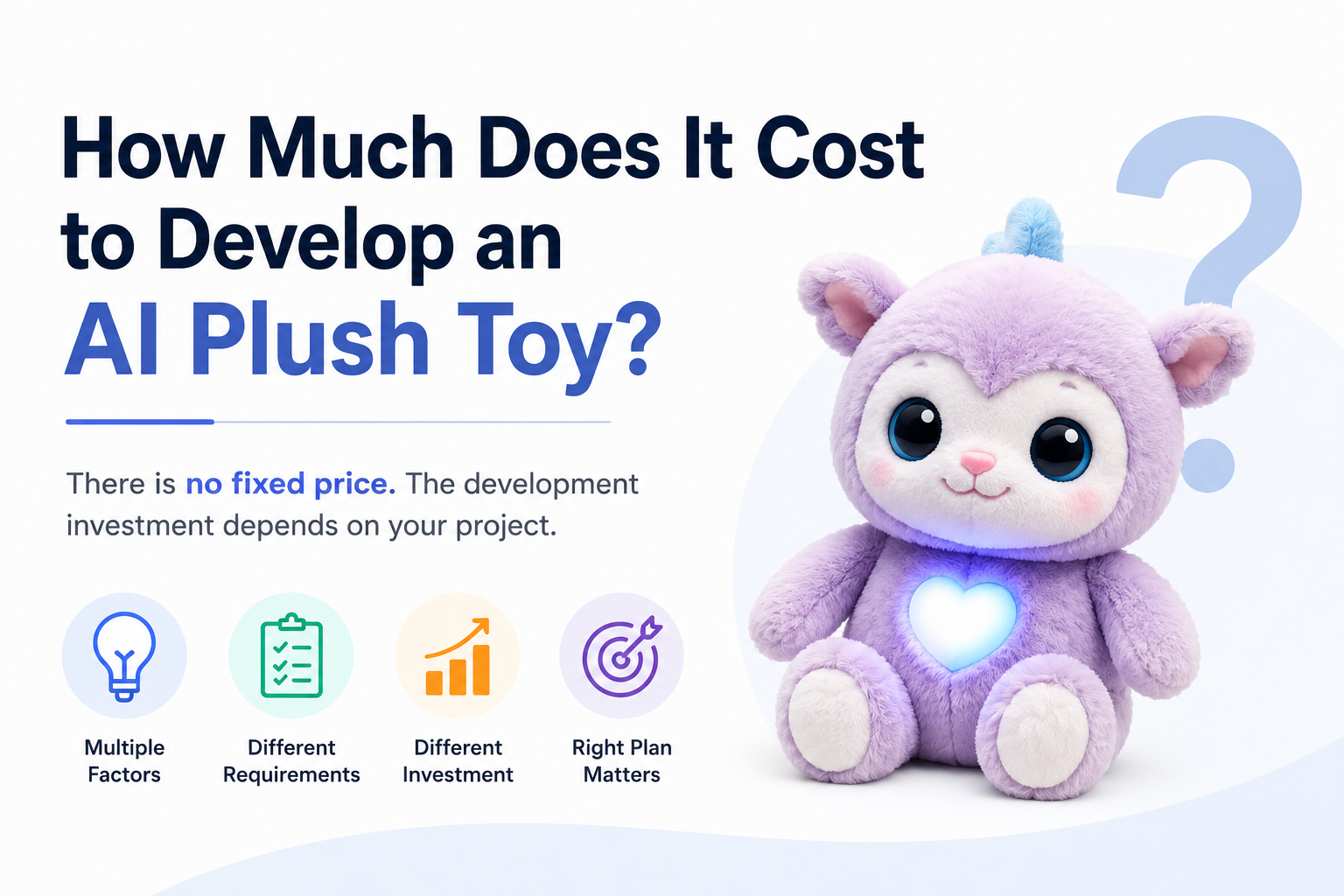
How Much Does It Cost to Develop an AI Plush Toy?
One of the first questions we hear from brands is:
"How much does it cost to develop an AI plush toy?"
It's a reasonable question—but it's also one of the most misunderstood.
Unlike traditional plush toys, AI companion toys are not standard products with fixed pricing. Every project has different goals, technical requirements, AI capabilities, and commercialization strategies.
That's why experienced AI toy development companies don't begin with a quotation.
They begin by understanding your project.
At Kidult Tech, we believe the best way to estimate development investment is to first define the product, understand your business objectives, and recommend the most suitable development strategy.
This guide explains what really influences the investment required to develop an AI plush toy—and how thoughtful planning can help you maximize value while controlling costs.
1. Why There Is No Standard Price for an AI Plush Toy
Many people expect AI plush toys to have a standard development cost.
In reality, every AI toy is different.
Two products may look similar on the outside but require completely different levels of engineering behind the scenes.
For example:
- One product may only need offline voice interaction.
- Another may require cloud AI, long-term memory, and a mobile app.
- One brand may customize an existing platform.
- Another may build entirely new hardware and software.
Although both products are AI plush toys, the development effort can be very different.
A professional proposal should always be based on project requirements rather than assumptions.
2. What Determines the Development Investment?
Instead of asking "What's the price?", it's more useful to ask:
"What factors influence the development investment?"
Several key elements determine the scope of an AI toy project.
Product Vision
Everything starts with the product itself.
Questions such as:
- Who are the target users?
- What experience should the toy provide?
- What makes the product different?
- What retail price are you targeting?
These decisions influence nearly every stage of development.
A clearly defined product vision helps avoid unnecessary engineering work later.
AI Features
Not every AI plush toy requires the same level of intelligence.
Projects may include features such as:
- Voice conversation
- Emotional interaction
- Memory functions
- Offline AI
- Cloud AI
- Hybrid AI
- Multi-language support
- Mobile app connectivity
The selected feature set directly affects software development, system architecture, and overall project complexity.
Engineering Scope
One of the biggest factors is deciding how much needs to be developed.
Some projects can build on an existing AI platform and focus on customizing the product experience.
Others require completely new electronics, firmware, mechanical structures, or software.
The broader the development scope, the greater the engineering investment.
Product Design & Manufacturing
Every physical product has its own manufacturing requirements.
Factors such as:
- Plush size
- Materials
- Mechanical structure
- Electronics integration
- Packaging
- Manufacturing process
all contribute to the final project scope.
A well-designed product not only improves user experience but also supports efficient mass production.
Compliance & Target Markets
Different markets require different certifications and testing.
Depending on where the product will be sold, development planning may include requirements related to safety, electronics, batteries, wireless communication, and toy regulations.
Considering compliance early in the project helps reduce redesign work later.
3. Why Experienced Manufacturers Don't Quote Too Early
Sometimes customers ask for a quotation before the product requirements have been fully defined.
While it's possible to discuss a preliminary budget, providing a fixed quotation too early is rarely responsible.
Professional AI toy development begins with understanding:
- Your product concept
- Business goals
- Target users
- AI functions
- Expected production volume
- Target markets
- Launch schedule
Only after these factors are understood can a realistic proposal be prepared.
At Kidult Tech, we believe transparent proposals are more valuable than quick quotations.
Our goal is to recommend the development approach that best fits your project—not simply provide a number.
4. How Smart Development Can Reduce Investment
Reducing development investment doesn't always mean removing features.
More often, it means making better development decisions.
For many projects, we recommend beginning with a proven AI platform and customizing the product around it.
This approach offers several advantages:
- Shorter development time
- Lower technical risk
- Faster prototype validation
- Earlier market entry
- Easier future upgrades
Once the product has been validated by the market, additional hardware or software customization can be introduced in later versions.
Rather than investing everything upfront, brands can make decisions based on real customer feedback.
5. Our Recommended Development Strategy
Based on our experience, many successful AI toy projects follow a phased development approach.
Phase 1 — Define the Product
Clarify your product concept, target users, business goals, and AI experience.
Phase 2 — Build a Prototype
Develop a working prototype to validate interaction, functionality, and user experience.
Phase 3 — Test the Market
Gather customer feedback through pilot programs, crowdfunding, or limited product launches.
Phase 4 — Optimize the Product
Refine AI features, improve hardware, and optimize manufacturing based on real-world feedback.
Phase 5 — Scale to Mass Production
Prepare the product for large-scale manufacturing with optimized quality, cost, and supply chain planning.
This phased strategy helps brands reduce uncertainty while making more informed investment decisions throughout the development process.
6. What Information Helps Prepare an Accurate Proposal?
You don't need to have every detail finalized before contacting us.
Many successful products begin with a simple idea.
However, the following information helps us prepare more accurate recommendations:
- Product concept
- Target users
- Expected AI features
- Target retail price
- Preferred launch timeline
- Target sales markets
- Estimated production volume
- Whether a mobile app is required
- Existing IP or character (if applicable)
If some of these details are still undecided, that's perfectly fine.
Our team can work with you to refine the product concept and identify the most practical development path before preparing a formal proposal.
Why the Right Development Strategy Matters More Than the Initial Budget
Many companies focus on one question:
"What's the cheapest way to build an AI plush toy?"
A better question is:
"What's the smartest way to develop an AI plush toy?"
The lowest initial investment isn't always the most cost-effective solution.
Likewise, the most advanced technology isn't always necessary for a successful product launch.
The right balance depends on your product goals, market strategy, timeline, and long-term vision.
Choosing the appropriate development strategy from the beginning often saves more time and resources than simply choosing the lowest quotation.
Conclusion
There is no single answer to the question:
"How much does it cost to develop an AI plush toy?"
Every project is unique.
The investment depends on your product concept, technical requirements, development scope, manufacturing strategy, compliance requirements, and long-term business objectives.
At Kidult Tech, we don't believe in one-size-fits-all quotations.
Instead, we work with brands to understand their ideas, recommend the most suitable development approach, and prepare transparent proposals based on real project requirements.
Because successful AI toys are not built by guessing the budget.
They are built through the right strategy.
Frequently Asked Questions
Can you provide an estimated budget before the product is fully defined?
Yes. We can discuss an estimated investment range based on your initial concept and recommend a suitable development approach. A formal proposal is prepared after the project scope has been clarified.
Does every AI plush toy require custom development?
No. Many projects can build on a proven AI platform while customizing the product's appearance, interaction, branding, and user experience. The most suitable approach depends on your business goals and product requirements.
What information should I prepare before contacting Kidult Tech?
Even if you only have an idea, we're happy to discuss it with you. Helpful information includes your target users, product concept, desired AI features, launch timeline, and target market, but these details can also be refined together during the development process.
Can I start with a ready platform and customize it later?
Yes. Many brands choose a phased development strategy—starting with a proven platform to validate the market before investing in deeper customization. This approach helps reduce technical risk while keeping future expansion options open.
Please give us a message