
Kidult Tech Blog | AI Plush OEM Insights
AI plush industry trends, OEM/ODM guidance & development insights for brands
How to Develop an AI Toy: Complete Guide from Idea to Mass Production | Kidult Tech
Artificial Intelligence is rapidly reshaping the toy industry. From AI companion plush toys and interactive pets to educational toys and smart collectibles, AI is creating entirely new ways for people to play, learn, and connect.
However, building an AI toy is very different from developing a traditional toy.
An AI product combines industrial design, electronics, embedded software, AI models, wireless communication, mobile applications, cloud services, certification, and manufacturing into one complete development process.
This is why many brands find the journey more challenging than expected. Questions such as Which AI model should we use?, Do we need an app?, Should we choose an existing platform or develop everything from scratch?, and How long will development take? often arise before a project even begins.
At Kidult Tech, we help brands simplify this process. Whether you're launching your first AI toy or expanding an existing product line, understanding the development journey will help you make better technical and business decisions.
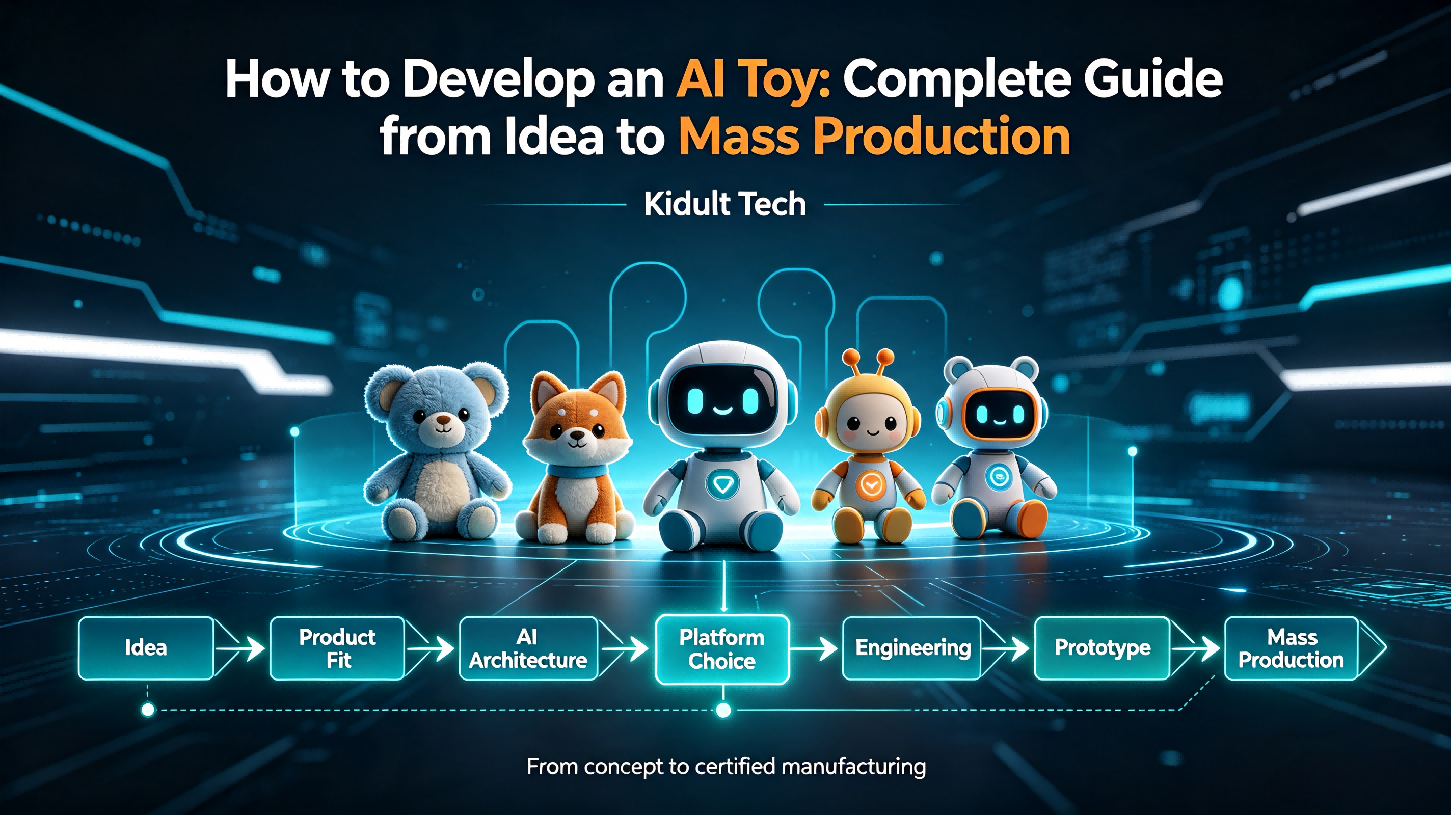
In this guide, we'll walk through each stage of AI toy development—from the initial idea to mass production.
1. Every Great AI Toy Starts with an Idea
Many companies believe they need a complete product specification before speaking with an AI toy developer.
In reality, that is rarely the case.
Some projects begin with nothing more than a sketch on paper. Others start with an existing plush toy that customers want to make interactive. Sometimes the only information available is a target retail price or a new character that needs an AI personality.
These are all perfectly valid starting points.
The role of an experienced AI development partner is not simply to manufacture a finished product—it is to help transform early ideas into realistic technical solutions.
Starting discussions early allows more flexibility to optimize functionality, development cost, production timeline, and user experience before major decisions have been locked in.
The earlier collaboration begins, the more opportunities there are to build a better product.
2. Start with the Product, Not the Technology
One of the most common mistakes in AI product development is choosing the technology before defining the product itself.
Instead, every project should begin by answering a few simple business questions.
For example:
- Who is the target user?
- Which country or region will the product be sold in?
- What retail price are you aiming for?
- What kind of interaction do you want users to experience?
- Is the product designed for education, emotional companionship, entertainment, or storytelling?
- Will it be based on an existing character or intellectual property (IP)?
These questions shape almost every technical decision that follows.
For example, an AI companion designed for daily conversations may require a completely different architecture from an educational toy that focuses on storytelling or language learning.
Technology should always support the product vision—not define it.
3. Choosing the Right AI Architecture
One of the biggest misconceptions in the market is that every AI toy needs the most advanced AI model available.
The reality is much more practical.
Different products require different AI architectures, depending on the intended user experience, performance requirements, and budget.
At Kidult Tech, we generally evaluate three approaches before recommending a solution.
Offline AI
Offline AI performs speech recognition and interaction directly on the device without relying on cloud services.
This approach offers several advantages:
- Fast response times
- Better privacy protection
- Lower operating costs
- Stable performance without an Internet connection
Offline AI is often a suitable choice for educational toys, storytelling products, or applications where privacy and reliability are particularly important.
Cloud AI
Cloud AI connects to online large language models, allowing products to deliver more dynamic and continuously evolving conversations.
Typical advantages include:
- Rich conversational experiences
- Continuous knowledge updates
- Flexible AI capabilities
- Easy expansion through cloud services
This architecture is commonly used for premium AI companion products that require open-ended conversations and constantly updated knowledge.
Hybrid AI
In many projects, the best solution is not choosing between offline or cloud AI—but combining both.
Hybrid AI processes simple commands locally for speed while sending more complex requests to cloud services.
This balance delivers a smoother user experience while helping control cloud operating costs.
Rather than asking "Which AI model is the best?", a better question is:
"Which AI architecture best supports the product we're trying to build?"
This is one of the most important decisions in any AI toy development project.
4. Ready-to-Sell Platform or Fully Custom Development?
Once the AI strategy has been defined, the next step is deciding how the product should be developed.
Today, most AI toy projects follow one of two development paths.
Option One: Ready-to-Sell AI Platform
For brands looking to enter the market quickly, an existing AI platform can significantly shorten development time.
Instead of building every component from scratch, manufacturers customize an already proven hardware and software platform.
This approach typically allows customization of:
- Plush appearance
- Character design
- Branding
- Packaging
- AI personality
- Language settings
- User experience
Because the core technology has already been validated, development risks are lower and products can usually reach the market much faster.
This option is particularly attractive for startups, retailers, distributors, and brands that want to validate market demand before investing in full custom development.
Option Two: Fully Customized AI Development
When product differentiation is the highest priority, fully customized development provides maximum flexibility.
Every aspect of the product can be designed specifically around the brand's vision, including:
- Product structure
- Electronics
- AI interaction
- Mobile application
- Cloud platform
- Character personality
- Industrial design
- User interface
Although this approach requires a longer development cycle and higher engineering investment, it creates a unique product that cannot easily be replicated by competitors.
For many established brands and IP owners, this is the preferred path for building long-term product value.
5. Engineering & Hardware Integration
Once the development approach has been defined, the project moves into engineering.
This is where an AI toy begins to take shape—not only as a concept, but as a real product.
Unlike traditional plush toys, an AI toy combines multiple engineering disciplines into a single product. Every component must work together reliably to deliver a natural and enjoyable user experience.
A typical AI toy may include:
- AI computing module
- Microphone and speaker system
- Battery and power management
- Wireless communication (Bluetooth or Wi-Fi)
- LED lights or interactive sensors
- Control buttons
- Plush structure and internal support
- Mobile App connectivity (if required)
At this stage, engineering is not simply about adding more features. It is about finding the right balance between performance, reliability, battery life, manufacturing cost, and user experience.
For example, a product designed for young children may prioritize simplicity, durability, and offline interaction, while an AI companion for teenagers or adults may require more advanced conversational capabilities and cloud connectivity.
The best solution is rarely the one with the most features—it is the one that best supports the product's purpose.
6. Prototype, Testing & Validation
After the hardware architecture has been finalized, the first prototype is built.
This stage is often where ideas become reality—and where improvements begin.
Very few successful AI toys reach production after the first prototype. Instead, development usually involves several rounds of testing and refinement to ensure the product performs reliably in real-world use.
Typical validation includes:
AI Interaction Testing
Evaluating conversation flow, response speed, wake-word performance, and overall interaction quality.
Audio Performance
Optimizing microphone sensitivity, speaker clarity, and volume balance to create a natural communication experience.
Battery & Power Testing
Measuring operating time, charging performance, standby consumption, and thermal stability.
Structural Validation
Ensuring the electronics fit securely inside the plush while maintaining appearance, durability, and comfort.
User Experience Evaluation
Observing how users interact with the product and identifying opportunities to improve usability, emotional engagement, and product stability.
Each prototype provides valuable feedback that helps reduce technical risks before mass production.
Investing time in validation early often saves significant time and cost later.
7. Certification & Compliance
Certification is sometimes treated as the final step of product development.
In reality, it should be considered from the very beginning.
Different countries have different regulatory requirements, and these requirements often influence hardware design, battery selection, wireless modules, and packaging.
Depending on the target market, AI toys may require certifications such as:
- CE
- FCC
- UKCA
- EN71
- RoHS
- PSE
- UN38.3 (for lithium battery transportation)
Planning for compliance early helps avoid unnecessary redesigns, repeated testing, and unexpected delays before launch.
For brands planning international distribution, certification is not simply a legal requirement—it is an important part of building a reliable product.
8. Preparing for Mass Production
Once engineering validation and certification planning have been completed, the project enters the manufacturing stage.
Mass production is much more than producing larger quantities.
It is about ensuring every unit consistently delivers the same quality, performance, and user experience.
Before production begins, several important activities typically take place:
- Final product verification
- Production process validation
- Supply chain confirmation
- Tooling preparation
- Quality control planning
- Packaging validation
- Pilot production
A pilot production run allows potential manufacturing issues to be identified before full-scale production begins, reducing both production risk and long-term costs.
For AI products, manufacturing quality is especially important because mechanical components, electronics, firmware, and software must work together as one complete system.
9. Start Earlier, Build Better
One of the biggest misconceptions in AI toy development is that brands need a complete specification before reaching out to a development partner.
The reality is quite different.
Many successful projects begin with a simple question:
"Can this idea become an AI toy?"
Sometimes a customer already has a finished product design.
Sometimes they only have a character.
Others may simply want to explore whether AI is the right fit for their brand.
Every project starts at a different stage, and that's perfectly normal.
Early collaboration often leads to better decisions because product positioning, AI architecture, engineering, manufacturing, and certification can all be considered together instead of separately.
Whether you're planning a ready-to-sell product or a fully customized AI companion, discussing your ideas early creates more opportunities to optimize development time, budget, and product performance.
You don't need to have all the answers before getting started.
You just need the right development partner.
Conclusion
Developing an AI toy is no longer limited to the world's largest toy companies.
With today's AI technologies and the right development strategy, brands of all sizes can create innovative AI-powered products that deliver meaningful user experiences.
Successful AI toys are built through a structured process—starting with a clear product vision, selecting the right AI architecture, validating the design through prototyping, planning for compliance, and preparing for reliable mass production.
At Kidult Tech, we believe every successful AI product starts with understanding the idea behind it.
Whether you're exploring your first concept or expanding an existing product line, our goal is to help transform innovative ideas into market-ready AI products.
Please give us a message